7 Car Audio Upgrade Mistakes That Cost You Sound Quality
Last Updated: November 19, 2026
Quick Summary
A car audio upgrade works best when every part is matched to your vehicle and how you listen. Match amplifier power to speaker RMS ratings, check fit for your door size and dash, and choose the Good, Better or Best tier that suits your goals.
- Check RMS power ratings on amplifiers and speakers, not peak numbers printed on the box.
- Amplifiers that deliver far more power than speakers can handle cause clipping and distortion.
- Confirm what installation includes, such as interface modules, sound-deadening or tuning.
- Simple jobs like door speakers suit DIY, while factory wiring and custom enclosures suit professionals.
- Compatible interface modules let a new head unit keep steering wheel controls working.
Table of Contents
- Why Your Car Audio Upgrade Starts With the Right Matching
- Car Audio Installation Cost: What You Pay For and Why It Varies
- DIY vs. Professional Installation: A Cost-Benefit Look
- Component Compatibility: Keeping Steering Wheel Controls, Cameras and Factory Features Working
- Best Car Audio Brands for Sound Quality: How to Judge Them Fairly
- Good, Better, Best: Choosing a Professional Car Stereo Upgrade That Fits You
- Maintenance, Troubleshooting and Your Next Step With HB Auto Sound OC
- Frequently Asked Questions
Why Your Car Audio Upgrade Starts With the Right Matching
Most car audio upgrades disappoint for the same reason. The parts were chosen one at a time, without asking whether they work together. At HB Auto Sound OC, we match the head unit, speakers, amplifier and wiring to your vehicle and how you actually listen. Get that match right and the upgrade sounds clean. Get it wrong and you pay for hardware that never performs.
Matching begins with power. An amplifier that delivers far more wattage than your speakers can handle will clip and distort, and that distortion destroys tweeters faster than almost anything else. A speaker rated for less power than your amp puts out can fail the first time you turn the volume up. Check the RMS ratings on both, not the peak numbers printed on the box.
Matching also depends on the vehicle. Door size, mounting depth, dashboard layout and factory amplifier all affect what fits and how it sounds. A component set that looks perfect on paper may need custom adapters or a custom enclosure to sit correctly in your car.
The most common mistake we see is buying the loudest-sounding parts first. A better approach is to decide what you want the system to do, then choose parts built to do that job together.
Car Audio Installation Cost: What You Pay For and Why It Varies
Installation cost is driven by labor hours and vehicle complexity. Two vehicles with the same head unit can require very different amounts of work, and understanding why helps you judge a quote fairly and avoid surprises.
The biggest labor drivers are dash and trim disassembly, factory amplifier bypass, wiring routing, and custom fabrication. A straightforward head unit swap in a vehicle with an open dash and no factory amplifier is a short job. A full system with a subwoofer enclosure, multi-channel amplifier, and sound-deadening in the doors and floor takes substantially longer because each layer of work has to be done without damaging clips, panels, or factory harnesses.
Vehicle architecture matters more than most buyers expect. Some dashes require removing the center console or climate panel to reach the radio. Vehicles with a factory amplifier often need a bypass harness or a signal interface so the new head unit talks to the rest of the system.
The parts-versus-labor split also shifts with your goals. A good-tier upgrade focuses on the head unit and speakers. A best-tier build adds amplification, a custom subwoofer enclosure, and tuning time.
When comparing quotes, confirm what is included, such as interface modules, sound-deadening, or tuning.
Quality installation work is where most of the value sits. If you want to see the steps behind the labor, read what a professional installation involves, or review a car stereo installation cost breakdown to compare the factors that move the number up or down. For a figure based on your specific vehicle, contact HB Auto Sound OC and we will walk through the work before anything begins.
DIY vs. Professional Installation: A Cost-Benefit Look
A do-it-yourself install can save labor, but the savings are real only when the job matches your tools, your vehicle, and your tolerance for risk. The honest way to decide is to compare what you save against what a mistake would cost in parts, time, and factory-system damage.
Start with the jobs that are genuinely DIY-friendly. Replacing a set of door speakers in a vehicle with easy panel access, no factory amplifier, and standard mounting depth is a reasonable first project. So is swapping a head unit in an older vehicle with a simple dash and no steering wheel controls or camera integration. These jobs use basic hand tools, follow clear wiring color codes, and fail in ways you can see and fix.
The jobs that punish DIY are the ones that touch factory data and factory wiring. A short in the wrong circuit can drain a battery, blow fuses, or damage modules that control the radio, climate, or safety features. Vehicles with integrated displays, backup cameras, parking sensors, or network data need interface modules, and wiring one incorrectly can disable features that were working before you started. Custom subwoofer enclosures are a separate skill set: air volume, port tuning, and mounting depth all affect output, and a box built to the wrong specs can make a good subwoofer sound worse than the factory system.
Watch out: a mistake on a tricky install often costs more to fix than the labor would have cost at the start, especially when a damaged factory module has to be replaced and reprogrammed.
Professional installation makes sense when the work touches factory wiring, requires a custom enclosure, or involves a vehicle with integrated controls.
A practical middle path is to do the simple work yourself and hand off the complex work. That keeps the labor bill focused on the tasks where skill actually changes the outcome. If you are unsure which side of the line your project falls on, contact HB Auto Sound OC and we will tell you honestly what is DIY-safe and what is not.
Component Compatibility: Keeping Steering Wheel Controls, Cameras and Factory Features Working
Many buyers worry that a new head unit will break steering wheel controls, backup cameras or chimes. That worry is reasonable, and it is solvable. Steering wheel controls use specific signal interfaces, and each vehicle manufacturer uses different wiring. A compatible interface module lets the new stereo read those signals so the buttons keep working.
Backup cameras and factory displays need their own handling. Some vehicles route camera video through the factory radio, so replacing the unit without the right interface can cut out the image. Other systems depend on data from the vehicle's network. Confirm which features your car uses before choosing a head unit.
Best Car Audio Brands for Sound Quality: How to Judge Them Fairly
Brand names matter less than how well a component suits your system. A well-designed speaker from one manufacturer can outperform a more expensive one from another if it matches your amplifier, enclosure and listening preferences.
When you compare brands, look at specifications that predict performance: sensitivity, frequency response, power handling and build quality. Listen for clarity at the volume you actually play music. Pay attention to how a speaker handles vocals and bass, since those are the parts most listeners notice first.
We carry select lines from authorized-dealer brands, and we focus on reliability and customer satisfaction. Our recommendations are based on what your vehicle needs and how you listen.
Good, Better, Best: Choosing a Professional Car Stereo Upgrade That Fits You
Every upgrade does not need to be the most expensive one. We use a simple three-tier approach so you can choose what fits your goals and budget.
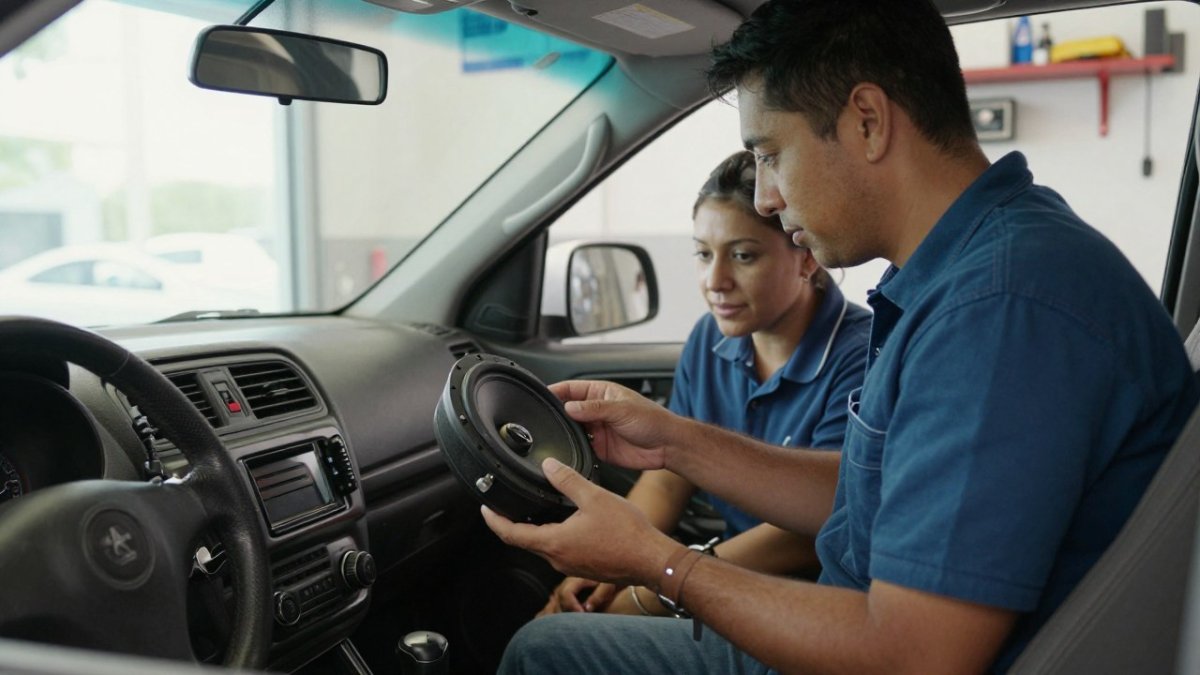
Good: A clean head unit upgrade with a speaker replacement. This delivers a noticeable improvement in clarity and makes the factory system sound fuller without major changes. It suits drivers who mostly want better sound for daily commuting.
Better: A component speaker set with an amplifier and proper sound-deadening. This adds clearer imaging, more dynamic range and stronger bass. It suits drivers who listen often and want the system to hold up at higher volume.
Best: A complete system with a subwoofer in a custom enclosure, multi-channel amplification and tuning. This suits enthusiasts who want the most detailed, powerful sound their vehicle can support.
Our full range of stereo and head unit installation services covers each tier, and a high-performance sports car example shows how the tiers apply to a specific type of vehicle. When you are ready to pick a tier, we can recommend the components that fit your vehicle and your listening habits.
!A technician in a clean shop reviewing a head unit and speaker options with a customer seated beside a car dashboard
The three tiers below summarise what each level of upgrade includes and who it suits.
| Tier | Typical upgrade | Best for |
|---|---|---|
| Good | Head unit upgrade with speaker replacement | Daily commuting, fuller factory-level sound |
| Better | Component speakers, amplifier, sound-deadening | Frequent listeners who want dynamic range at volume |
| Best | Subwoofer in custom enclosure, multi-channel amps, tuning | Enthusiasts seeking the most detailed, powerful sound |
Maintenance, Troubleshooting and Your Next Step With HB Auto Sound OC
A well-installed system needs little maintenance, but a few habits keep it performing well. Check connections if you notice crackling or dropouts. Keep the amplifier ventilated, since heat shortens its life. If a speaker sounds distorted at moderate volume, have it checked before it fails completely.
When sound problems appear after an upgrade, start with the basics: check grounds, confirm the amplifier gain is set correctly, and make sure power wiring is secure and properly fused. Many issues trace back to a loose connection or a gain setting that is too high.
If you are ready to take the next step, contact HB Auto Sound OC to ask questions about your vehicle or request a quote. Our team can review your options and recommend a plan that fits your goals.
Frequently Asked Questions
How much does it cost to put a sound system in my car?
Costs depend on the components you choose, the vehicle, and the amount of custom work involved. A basic head unit and speaker swap is far less work than a full system with amplifiers, subwoofers and sound-deadening. For current pricing on your specific vehicle and goals, contact HB Auto Sound OC directly for a quote, since a shop can only give an accurate figure after reviewing your car and what you want the system to do.
How do I know if my car audio installer is certified?
Ask for specific credentials and check them yourself. HB Auto Sound OC has certified installers and is an authorized dealer for its top-brand equipment, Ask which technicians will work on your car, what training they have completed, and how the installation will be documented. A reputable shop will answer these questions without hesitation.
Is it worth upgrading my factory car speakers?
In many vehicles, factory speakers are the weakest link in the audio chain. Replacing them with quality speakers that match the car's mounting locations and the power your head unit can deliver often produces a noticeable gain in clarity and bass response. The benefit depends on your vehicle and listening habits, so a consultation helps determine whether speakers alone or a broader upgrade makes the most sense.

Ready to Upgrade Your Ride?
Call us at (714) 842-1250 or visit us at 16732 Beach Blvd Ste A, Huntington Beach.
Get a Free Quote