
Car Stereo Installation Cost: What to Expect
Table of Contents
- What Drives Car Stereo Installation Cost
- Car Stereo Installation Price Factors You Should Know
- How Car Stereo Installation Time Affects Your Quote
- Car Speaker Installation Cost Breakdown
- The Role of a Car Stereo Installation Kit
- Professional Installation vs. DIY: A Cost Reality Check
- What Warranty and Workmanship Guarantees Mean for Your Investment
- Getting an Accurate Quote for Your Vehicle
- Frequently Asked Questions
Last Updated: October 16, 2026
What Drives Car Stereo Installation Cost
The price of a car stereo installation depends on more than the equipment you choose.
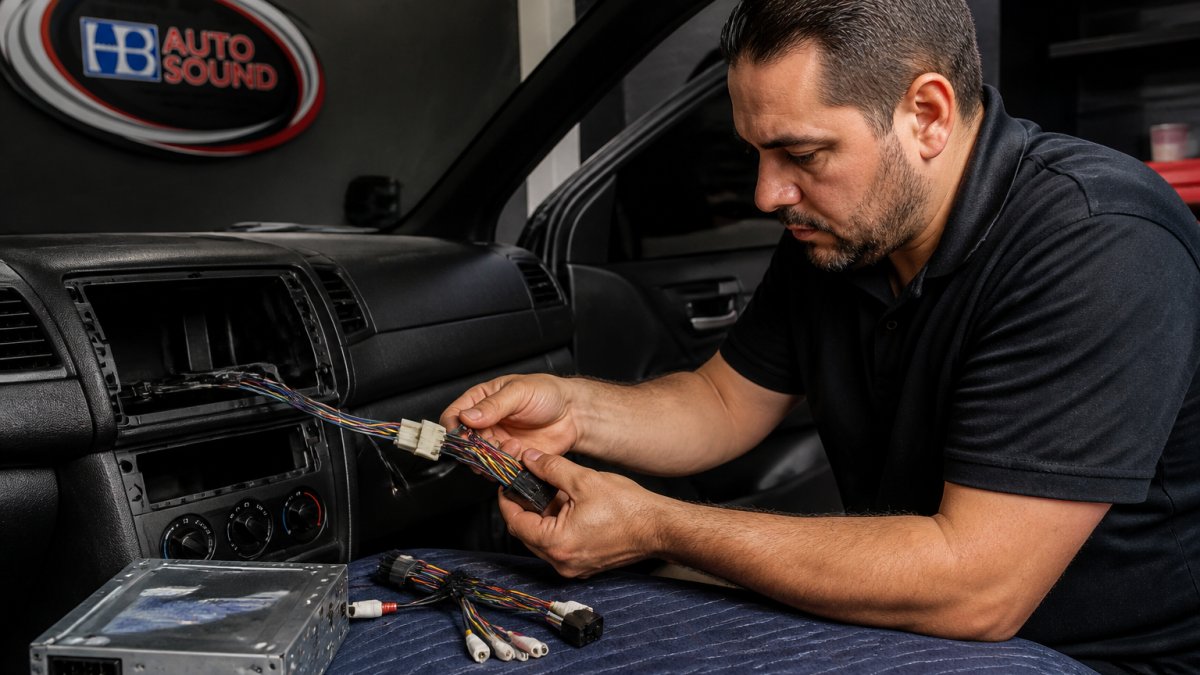
The real cost drivers aren't always obvious. A basic head unit swap takes different skill and time than retrofitting a touchscreen into a car with factory integration.
Car Stereo Installation Price Factors You Should Know
Several factors shape what you'll pay for car stereo installation. The most significant is your vehicle: its age, factory system complexity, and integration level. Beyond that, the components and the labor to install them cleanly determine your total investment.
Head Unit Complexity and Compatibility
A head unit (also called an in-dash deck or car radio) is the centerpiece of your audio system.
Single-DIN head units fit most vehicles without modification and install quickly. Double-DIN units take twice the space and often require a dash kit.
A head unit compatible with your wiring harness and steering wheel controls installs faster than one requiring custom solutions.
Factory System Integration
Modern vehicles, especially luxury and higher-trim models, have factory amplifiers and integrated audio systems that complicate upgrades.
Factory amplifiers require signal processors or line output converters to integrate with aftermarket head units. Backup cameras and steering wheel controls add complexity, sometimes demanding specific adapters or reprogramming.
Understanding your vehicle's factory setup before you shop helps you budget realistically, because what seems simple often involves factory system constraints.
Additional Components and Wiring
Beyond the head unit, additional components drive complexity and cost. Speakers require mounting brackets, sound dampening, and careful wiring. A subwoofer demands a custom enclosure and amplifier integration.
Each component adds labor time and materials. Quality wiring harnesses, adapters, and installation kits are essential for a clean, reliable installation; cutting corners creates noise, interference, and electrical problems later.
How Car Stereo Installation Time Affects Your Quote
Installation time is the single biggest lever on your labor bill, and the number most shoppers underestimate. Understanding what consumes those hours is how you sanity-check any quote.
Typical labor-hour ranges by job
These are the ranges most experienced installers work from; your vehicle and components move you up or down within them.
- Single-DIN head unit swap, basic vehicle: roughly 1 to 2 hours. Factory radio out, harness and dash kit in, new deck seated and tested.
- Double-DIN or touchscreen head unit, basic vehicle: roughly 2 to 3 hours. Larger dash opening, more trim work, backup-camera and USB routing if equipped.
- Head unit with steering-wheel-control retention and factory amp integration: roughly 3 to 5 hours. Requires an interface module, sometimes a line output converter or DSP, and a programming step.
What actually eats the hours
Time is spent on the hidden work, not the visible work:
- Trim and panel removal. Clips break. Retaining tabs hide behind other panels. A careful installer spends real time on removal and reassembly so nothing rattles afterward.
- Firewall pass-through. Getting amplifier power from the battery into the cabin requires finding or creating a safe grommet path, never through a door jamb or alongside factory harnesses.
- Signal routing. RCA cables must run away from power cable to avoid alternator whine. That constraint often means a longer, slower path than the shortest one.
- Interface programming. Steering-wheel controls, factory amp turn-on, and retained accessory power often require a module that must be flashed or configured.
- Testing and tuning. Gain setting, crossover points, and a listening check add time that a rushed shop skips, and that you hear later as noise or distortion.
How shop rate structure affects the final number
Most shops quote one of three ways, and the structure matters as much as the rate:
- Flat-rate by job. The shop has a book time for "double-DIN install, 2018 sedan, with SWC" and quotes that number regardless of how long it actually takes. Predictable for you; the shop absorbs overruns.
- Hourly. You pay for actual time. Cheaper on easy jobs, riskier on vehicles that fight back.
- Package pricing. Bundled labor for a defined scope (head unit + speakers, for example). Best when you are doing several upgrades at once.
Why "book time" and "real time" diverge
A vehicle that has been apart before, aftermarket alarm, previous stereo, dashcam wiring, almost always takes longer than book time, as does a car with brittle plastics or a previously broken trim piece. A shop that has done your exact year, make, model, and trim many times will quote tighter and finish closer to estimate.
Car Speaker Installation Cost Breakdown
Speakers are often the biggest bang-for-buck upgrade in car audio, but installation complexity varies significantly depending on what you're replacing and where.
Speaker Pair Installation
A basic speaker pair installation involves removing factory speakers and mounting aftermarket units in their place. This sounds simple but often isn't: factory mounting doesn't always align with aftermarket dimensions, requiring custom brackets or mounting rings, and door panels need careful removal to avoid damage.
Difficulty depends on your vehicle: some cars have straightforward door access, others require removing panels and clips that take time to reassemble. Professional car audio installation ensures speakers are mounted securely, wired properly, and tuned for your vehicle's acoustic environment.
Subwoofer and Amplifier Addition
Adding a subwoofer and amplifier significantly increases complexity. A subwoofer requires a prefabricated or custom box and enclosures option, mounted securely and sealed properly for performance.
An amplifier demands proper power distribution from your battery, grounding to the vehicle frame, and signal wiring from the head unit. Proper installation means running power cables safely, grounding to solid metal, and routing signal cables away from power cables to minimize noise, work that takes time and expertise.
The Role of a Car Stereo Installation Kit
An installation kit is often overlooked but essential. These kits typically include a wiring harness connecting your aftermarket head unit to factory wiring, plus a dash kit to make the new head unit fit properly.
Without the right kit, installation becomes a custom job: splicing wires, fabricating brackets, and solving compatibility problems on the fly.
Quality kits include proper connectors, color-coded wires, and vehicle-specific adapters. Cheap kits create poor connections, noise, and compatibility issues that surface weeks later.
Professional Installation vs. DIY: A Cost Reality Check
A real cost comparison lines up the same job done both ways and lets the numbers speak. Here is what that looks like for a typical mid-complexity upgrade: a double-DIN touchscreen head unit with steering-wheel-control retention in a vehicle with a factory amplifier.
The DIY column
DIY looks cheap until you itemize it.
- Head unit and install kit. You still buy the deck, the vehicle-specific dash kit, the wiring harness, and the SWC interface module. These are the same parts a shop buys, no savings there.
- Tools you probably do not own. Trim removal tools, a plastic pry set, crimpers, heat shrink, a multimeter, a torque driver for grounding points, and often a soldering iron. If you are starting from zero, this is a meaningful one-time outlay.
- Time. A first-timer on this job should budget two to three times the book hours. A job a shop finishes in an afternoon can consume a full weekend.
The professional column
- Labor. Quoted as a defined scope, usually flat-rate or package-priced for this kind of job.
- Parts. Same harness, dash kit, and interface module, but the shop already stocks or can source them correctly the first time.
- Warranty. Workmanship coverage on the install itself, plus the manufacturer warranty on the equipment, honored through the shop.
Where DIY actually wins
DIY is a reasonable choice in a narrow set of cases:
- Older, simple vehicles with a single-DIN opening, no factory amp, no steering-wheel controls, and no backup camera.
- You already own the tools and have done similar work before.
- The upgrade is cosmetic or low-stakes, a speaker swap in a car with easy door access, for example.
Outside those cases, the math rarely favors DIY once you count tools, time, and the probability of rework.
The hidden line item: fixing a failed DIY job
This is the part most comparisons leave out. When a DIY install goes wrong, the shop is not just redoing the work, it is diagnosing someone else's wiring, which takes longer than starting fresh. Common failure modes we see:
- Factory amp not turning on because the turn-on lead was not wired to the correct interface output.
- Steering-wheel controls dead because the SWC module was never programmed or was wired to the wrong resistance value.
- Alternator whine from RCA cables run alongside power cable.
Each of these is a diagnosis-and-repair job, not a simple reinstall. That is the real cost of a DIY attempt that does not go to plan.
How to decide
Ask yourself three questions:
- Does my vehicle have a factory amplifier, integrated display, or steering-wheel controls? If yes, the integration work is the hard part, and it is where DIY most often fails.
- Do I already own the tools and have I done this before? If no to either, add the tool cost and a significant time multiplier to the DIY column.
- What is my tolerance for rework? If a weekend of troubleshooting is acceptable, DIY is on the table. If not, professional installation is the lower-risk path.
What Warranty and Workmanship Guarantees Mean for Your Investment
A reputable shop stands behind its work with warranty coverage on parts and labor, plus a commitment to fixing installation-related problems.
Workmanship guarantees protect you if something fails due to how the system was installed. A loose connection, improper grounding, or damaged wiring should be addressed at no cost.
When you get a quote, ask what's covered: is the head unit warranty honored, are speakers guaranteed against rattle or failure, what happens if the backup camera stops working?
This matters because installation creates dependencies.
Getting an Accurate Quote for Your Vehicle
The only way to get an accurate quote is to provide specific information about your vehicle and what you want to install.
Walk into a shop with this information and you'll get a realistic quote.
At HB Auto Sound OC, we've spent over 15 years learning how different vehicles respond to different upgrades. Our vehicle audio specialist team understands factory integration challenges across makes and models, knows which components work best for your vehicle and use case, and can recommend the right components and explain exactly what installation involves.
The quote you receive should feel transparent, with labor time, parts, materials, and custom work itemized.
Getting the right car stereo installation means understanding what drives the cost and why professional expertise matters.
Frequently Asked Questions
What factors affect car stereo installation cost the most?
Vehicle compatibility is the biggest factor. Factory-integrated systems with steering wheel controls, backup cameras, and display integration require more labor and specialized adapters. Head unit complexity, whether you're adding speakers or amplifiers, and custom fabrication needs also significantly impact the total. A straightforward single-DIN swap differs greatly from upgrading a factory touchscreen system with factory amplifiers and integrated controls.
How long does it typically take to install a car stereo?
The time required for installation varies significantly based on the complexity of the upgrade and your vehicle's specific features. Factors like adding speakers, amplifiers, or subwoofers, as well as custom fabrication needs, can extend the timeline. Vehicle-specific factors like factory amplifier removal, steering wheel control integration, and dash kit customization all add installation time.
Is professional car stereo installation worth the labor cost?
Professional installation protects your investment. Certified installers ensure proper wiring, secure speaker mounting, correct amplifier configuration, and factory feature integration. Poor installation causes rattling speakers, blown fuses, electrical issues, and voided warranties. With 15+ years of experience, professional installers handle complex factory systems that DIY attempts often damage, making the labor cost a safeguard against costly mistakes.
What should I ask before booking a car stereo installation?
Ask about warranty coverage on both parts and labor, how long the installation takes, whether your factory features will work with the new system, what's included in the installation kit, and what happens if issues arise post-installation. Request a detailed estimate itemizing equipment, labor, and any custom fabrication. Verify the shop's experience with your specific vehicle and ask about their process for testing after installation.
Ready to Upgrade Your Ride?
Call us at (714) 842-1250 or visit us at 16732 Beach Blvd Ste A, Huntington Beach.
Get a Free Quote