Custom Car Audio: A Complete Upgrade Guide

Table of Contents
- What Custom Car Audio Includes
- Understanding Car Audio System Upgrades
- Factory Stereo Upgrade Options
- Car Subwoofer and Amplifier Selection
- Marine Audio Installation and Specialized Systems
- Professional Installation vs. DIY Considerations
- Vehicle Compatibility and System Matching
- Frequently Asked Questions
Last Updated: October 14, 2026
What Custom Car Audio Includes
Custom car audio means upgrading a vehicle's sound system with premium components tailored to your needs. At HB Auto Sound OC, we've spent over 15 years building personalized audio experiences.
A complete custom car audio system combines a head unit, quality speakers replacing factory units built for volume rather than clarity, subwoofers adding depth stock systems can't deliver, amplifiers providing clean power, and wiring, installation, and tuning tying it together.
The real difference between factory and custom isn't expensive parts, it's intentional design, with every component chosen for your vehicle and listening preferences.
Understanding Car Audio System Upgrades
A car audio system upgrade means replacing or enhancing components to improve sound quality, clarity, and performance, from a simple head unit swap to a complete custom build. The key is matching the upgrade to your goals: clear dialogue for podcasts, deep bass for music, or a balanced system that handles everything.
Good, Better, Best: Component Tiers
We approach custom car audio with three tiers, a framework that avoids overspending while ensuring real performance gains.
Good Tier focuses on reliable, proven components that noticeably improve on factory systems: quality speakers, a modern head unit with smartphone integration, and basic amplification.
Better Tier adds refinement: a dedicated subwoofer with a quality enclosure, multiple amplifiers for different frequency ranges, and premium speaker materials.
Best Tier is where custom car audio becomes truly personal: multiple amplifiers, custom-built enclosures designed for your vehicle's acoustics, high-end components from brands known for reliability and performance, professional sound tuning, and sometimes video systems.
Factory Stereo Upgrade Options
Many vehicles today have integrated factory systems controlling climate, navigation, and steering wheel functions, a real challenge when upgrading.
The good news: you don't have to lose these features. The key is the right head unit and proper integration during installation.
Preserving Factory Features During Upgrades
Factory systems integrate deeply with your vehicle's electronics, steering wheel controls, backup camera, and climate display all connect through the same system, and a careless upgrade can break these connections.
At HB Auto Sound OC, our car audio installation service has handled countless factory system upgrades in vehicles with complex integrations. We verify compatibility before any work begins, ensuring your steering wheel controls, backup camera, and other factory features work exactly as before.
Car Subwoofer and Amplifier Selection
A subwoofer handles the low frequencies factory speakers can't reproduce, and an amplifier provides clean, powerful signal to drive your components. Together they transform the listening experience, but only when matched correctly.
The Numbers That Actually Matter
RMS power, not peak power. Peak numbers are marketing; RMS numbers are engineering. Match the amplifier's RMS output at the subwoofer's rated impedance to the subwoofer's RMS rating.
Impedance (ohms) and wiring configuration. Subwoofers come in single-voice-coil (SVC) and dual-voice-coil (DVC) versions, typically 2Ω or 4Ω per coil.
Enclosure alignment. Sealed boxes are smaller with tight, accurate bass; ported boxes are larger but play louder and lower around their tuning frequency; bandpass designs are efficient but narrow.
Matching Amplifier Channels to the System
A modest system might use one multi-channel amplifier; complex setups separate duties:
- Mono (1-channel) amplifier, dedicated to subwoofers, optimized for low-frequency current delivery.
- 4-channel amplifier, typically drives front and rear speakers, with the front channels often bridged or run active for better staging.
- Dedicated tweeter/midrange amplifier, used in three-way active systems where each driver gets its own amplified band.
Separating duties lets each amplifier run in its most efficient range with independent level control per band.
Setting Gain, Crossover, and Bass Boost Correctly
Gain is not a volume knob, it matches the amplifier's input sensitivity to the head unit's preamp output voltage. Setting gain by ear, or turning it all the way up, destroys subwoofers.
The subwoofer amplifier's low-pass crossover should be set so the sub only reproduces frequencies below where the midbass drivers roll off, commonly 60-80 Hz. Overlap creates boomy bass; a gap creates a thin, hollow sound.
Bass boost is a narrow EQ bump centered around 40-50 Hz.
Electrical System Headroom
Every watt the amplifier produces comes from your vehicle's electrical system. A stock system comfortably supports about 500-800W RMS of total amplification before voltage drop becomes audible. Beyond that, upgrades to the alternator, battery, and wiring (the "Big 3", alternator-to-battery positive, engine-block-to-chassis ground, and battery-to-chassis ground) prevent dimming lights, amplifier shutdowns, and reduced output. This is where a boutique shop's experience pays off: we size the electrical system to the amplifier load before the install begins, and our upgraded automotive charging systems ensure your vehicle can reliably support the power your system demands.
Marine Audio Installation and Specialized Systems
Custom car audio principles apply to boats and RVs, but salt water, moisture, temperature swings, and vibration create unique challenges.
Marine audio systems require moisture-rated components, standard car audio corrodes quickly in a marine environment.
RV audio systems face different demands: limited space, constrained electrical power, and a listening environment that changes as you move. A system that works parked may perform differently while driving.
Boat and RV installation requires specialized knowledge: vibration isolation becomes critical, wiring runs must account for moisture and movement, and enclosure design works differently in these environments.
Professional Installation vs. DIY Considerations
The difference between a system that sounds great and one that disappoints often comes down to installation quality, not component cost. But most custom car audio work requires expertise that takes years to develop.
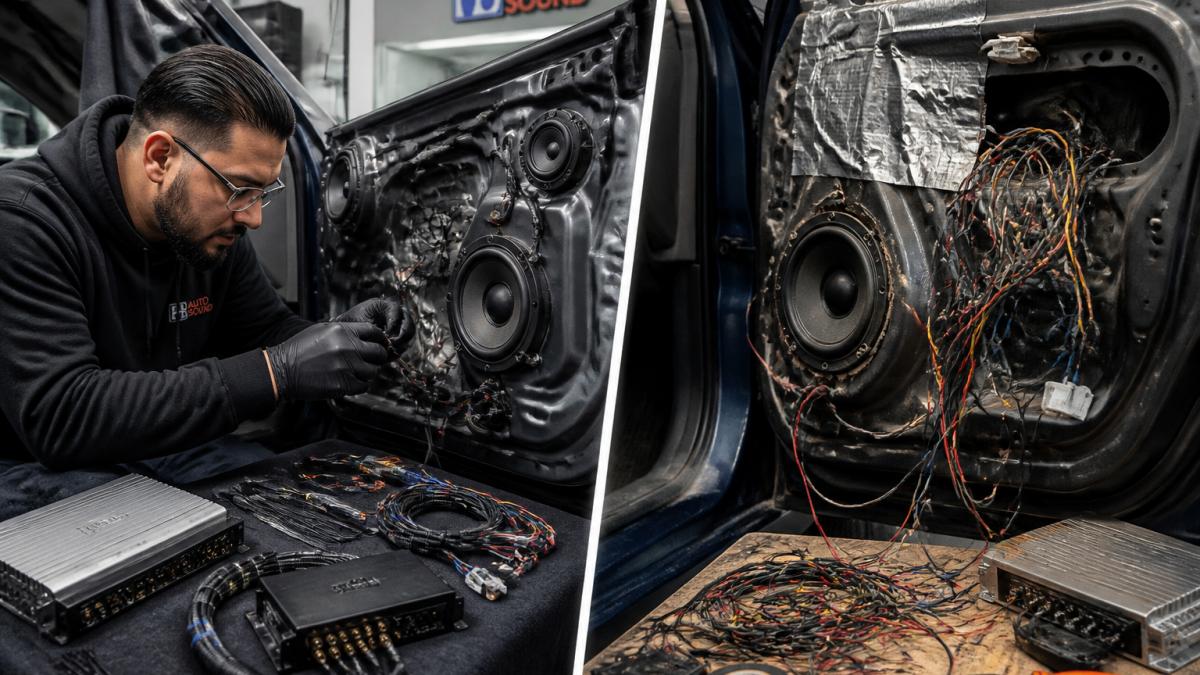
Professional installation ensures proper wiring, correct speaker mounting, and accurate tuning.
Common DIY mistakes include improper grounding (noise and electrical issues), incorrect speaker mounting (rattles and poor sound), inadequate amplifier cooling (shortened lifespan), and poor enclosure construction (wasted subwoofer potential).
At HB Auto Sound OC, our certified installers have worked on hundreds of vehicles and know the quirks of different makes and models.
Vehicle Compatibility and System Matching
Not every component works well in every vehicle. Size, electrical capacity, available space, and factory system integration all affect what will work, the parts that fit and perform are determined by measurements and specs, not brand loyalty.
Fitment: The Measurements That Decide Everything
Speaker mounting depth. Door and rear-deck speakers have a maximum mounting depth, the distance from mounting surface to magnet back.
Tweeter locations. Factory tweeter pods, A-pillars, and sail panels each have mounting constraints, and aftermarket tweeters often need custom brackets or flush-mount cups.
Subwoofer enclosure space. Trunk, hatch, crew cab, and SUV cargo areas offer different usable volumes. Our custom box and enclosures service builds solutions tailored to your vehicle's unique dimensions and your listening preferences.
Electrical Compatibility
Your vehicle's charging system sets the ceiling on amplifier power. Alternator output, battery capacity, and factory wiring gauge all factor in, a compact sedan with a 90-amp alternator has far less headroom than a full-size truck with a 220-amp unit. Before recommending amplifiers, we check:
- Alternator rated output (amps)
- Battery type and age
- Factory ground and power wire gauge
- Whether the vehicle uses a smart charging system that varies voltage based on load
Vehicles with smart charging systems may need a voltage stabilizer or an amplifier that tolerates variable input voltage. Ignoring this causes intermittent amplifier shutdowns.
Factory System Integration
Modern vehicles route climate, navigation, steering wheel controls, backup cameras, and vehicle settings through the factory head unit or central display. Replacing it without the right interface module means losing those functions. The integration path depends on the vehicle:
- Retained accessory power and data bus, many vehicles use CAN bus or similar networks; the new head unit or interface must speak that protocol.
- Amplified factory systems, vehicles with factory amplifiers often need a line output converter or a digital signal processor (DSP) to feed aftermarket amps a clean signal.
- Steering wheel controls, require a vehicle-specific interface module to translate button presses into commands the new head unit understands.
- Backup camera and parking sensors, need a retention harness or a compatible head unit input.
A DSP is often the unsung hero: it takes the factory signal, corrects its equalization and time alignment, and sends clean, tuned output to aftermarket amplifiers, preserving factory features while dramatically improving sound.
Vehicle-Specific Constraints by Category
- Compact cars and hatchbacks, limited door depth, small trunk volumes, tight dash openings. Powered subwoofers under a seat or in a spare-tire well are common solutions.
- Full-size trucks and SUVs, generous space but high noise floors and long cabins that demand more amplifier power and careful time alignment.
- Electric vehicles, quiet cabins reveal factory system flaws, but amplifier power must be tapped from the 12V system, not the traction battery. Noise isolation and DSP tuning matter more than raw wattage.
- Convertibles, open-air listening requires more output and different staging; components that sound great with the top up can sound thin with it down.
- Vehicles with integrated displays, often the factory screen must stay; upgrades focus on speakers, amplifiers, DSP, and subwoofer rather than the head unit.
How We Match a System to Your Vehicle
The process starts with measurements, not recommendations. We verify speaker locations and depths, measure usable enclosure space, check the charging system, and identify the factory integration path. Only then do we propose components, built around your listening habits, not a one-size-fits-all package.
This is where a boutique approach differs from a big-box install. We stock select lines chosen for reliability and customer satisfaction, and we know how those lines behave in specific vehicles, experience that turns a pile of good parts into a system that fits, integrates, and sounds right the first time.
Frequently Asked Questions
What does a custom car audio system include?
A custom car audio system typically includes a head unit (receiver), speakers, subwoofers, amplifiers, and wiring components tailored to your vehicle. The specific components depend on your sound goals and vehicle type. A professional installer will recommend a package that matches your listening preferences, vehicle acoustics, and budget. Many systems also include custom enclosures, sound deadening material, and integration with factory steering wheel controls and backup cameras to preserve your vehicle's original functionality.
How do I know if I need an amplifier for aftermarket car speakers?
An amplifier increases power delivery to your speakers, improving clarity and volume. If you want noticeably better sound than your factory system, an amplifier is typically recommended, especially for subwoofers. A head unit alone may not provide enough power for high-quality speakers to perform at their best. A professional installer can assess your vehicle's electrical system and your listening goals to determine whether an amplifier will make a meaningful difference in your setup.
Can custom audio systems be installed in boats and RVs?
Yes, custom audio systems can be installed in boats and RVs, though they require specialized knowledge of marine and recreational vehicle electrical systems. These installations must account for different power sources, moisture exposure, and space constraints compared to cars. Marine audio components are engineered for saltwater and humidity environments. Professional installers experienced with marine audio installation understand the unique challenges of these vehicles and can design systems that perform reliably in demanding conditions.
How do I keep my steering wheel controls and backup camera working after upgrading my factory stereo?
Modern vehicles integrate steering wheel controls and backup cameras into the factory head unit. A professional installer uses interface modules and proper wiring techniques to retain these functions when replacing your stereo. This requires knowledge of your specific vehicle's electrical architecture. Attempting this yourself risks damaging these safety features. An experienced installer will ensure your new head unit communicates correctly with your vehicle's factory systems, preserving all original functionality while delivering improved audio performance.
Ready to Upgrade Your Ride?
Call us at (714) 842-1250 or visit us at 16732 Beach Blvd Ste A, Huntington Beach.
Get a Free Quote