Alternatives to Factory Car Stereos: A 2026 Guide
Table of Contents
- Why Replace Your Factory Car Stereo
- Aftermarket Head Units and Single-DIN/Double-DIN Receivers
- Car Stereo with Apple CarPlay and Smartphone Connectivity
- Car Audio Upgrade Without Replacing Head Unit
- Car Amplifier for Factory Stereo Power and Performance
- Headless Audio Systems and DSP-Based Solutions
- Installation Complexity, Warranty, and Professional Expertise
- Choosing the Right Alternative for Your Vehicle and Listening Needs
- Frequently Asked Questions
Last Updated: October 18, 2026
Why Replace Your Factory Car Stereo
Your factory car stereo was engineered to meet minimum audio standards, not deliver premium sound.
At HB Auto Sound OC, we've worked with hundreds of vehicle owners who discovered that upgrading their audio system transformed their daily commute.
You have multiple pathways forward: replace the head unit entirely, upgrade components around your factory radio, or build a completely custom system.
Aftermarket Head Units and Single-DIN/Double-DIN Receivers
An aftermarket head unit is the most direct alternative to a factory car stereo. It replaces your factory radio and becomes the control center for the entire audio system. Form factor and retained-feature support determine whether a head unit works in your vehicle, so settle both before comparing models.
Single-DIN vs. Double-DIN: Which Fits Your Dash
Single-DIN receivers occupy a standard radio opening roughly 2 inches tall and 7 inches wide. They suit older vehicles, tight dash spaces, and builds where the head unit is a source and controller rather than a display.
Double-DIN receivers are twice as tall and typically house a 6.5- to 7-inch touchscreen. They are the standard for modern vehicles and the usual pick for Apple CarPlay, Android Auto, backup-camera display, and a clean factory-like look.
A practical decision sequence:
- Measure the opening. Confirm whether your dash accepts a single-DIN, a double-DIN, or a modular opening that accepts either with the right kit.
- Check depth and clearance. Shallow dashes and vehicles with HVAC ducts or factory amplifiers behind the radio can rule out deep-chassis units.
- Confirm retained features. Steering-wheel controls, backup camera, factory amplifier, USB ports, and vehicle settings menus each need the correct interface module or harness.
- Choose the display size last. Screen size is a preference; fitment and integration are constraints.
What 'Retained Features' Actually Means
Replacing a factory radio is straightforward in a base vehicle and considerably more involved in a modern one. Features most often at risk:
- Steering-wheel controls, retained through a vehicle-specific interface module that decodes the factory button signals and translates them to the new head unit.
- Backup and 360-degree cameras, retained through a camera retention harness or, in some vehicles, a dedicated adapter that converts the factory camera signal.
- Factory amplifier, retained through an amplifier integration harness, or bypassed entirely if you are building a new amplification stage.
Dash Kits, Brackets, and Trim
A dash kit adapts the factory opening to the aftermarket chassis and restores a finished, factory-like appearance. Kit quality affects the final look as much as the head unit itself; poorly matched trim produces gaps, rattles, and color mismatches. Select brackets and trim for your exact vehicle and head-unit combination; integrated or luxury dashes sometimes require custom fabrication.
Matching the Head Unit to the Rest of the System
A head unit is only as good as the signal chain behind it. Preamp output voltage, the number of preamp outputs, built-in processing, and DSP support determine how far the system can grow.
At our shop, we treat head-unit selection as the first decision in a system plan, not an isolated purchase. Our car audio sales and car audio installation services ensure that your selection is paired with professional fitment and integration tailored to your vehicle's architecture.
Car Stereo with Apple CarPlay and Smartphone Connectivity
A car stereo with Apple CarPlay or Android Auto transforms your head unit into an extension of your phone, providing navigation, messaging, music streaming, and hands-free control.
Wireless Apple CarPlay eliminates the need for a USB cable, though some units still offer wired connectivity as a backup.
When evaluating a car stereo with Apple CarPlay, confirm whether it supports both wireless and wired connections, and verify that the touchscreen is responsive and the interface mirrors your phone reliably.
Car Audio Upgrade Without Replacing Head Unit
Not every vehicle is a good candidate for head-unit replacement. Some integrated factory systems resist modification, and some drivers prefer to keep their factory radio. If that's your situation, you still have meaningful upgrade options.
Bluetooth for Factory Car Stereo Integration
The simplest upgrade is adding Bluetooth connectivity to your factory stereo. A Bluetooth receiver module connects to your factory radio's auxiliary input or integrates with the factory amplifier, letting you stream music wirelessly from your phone.
This approach preserves all factory features, steering wheel controls, backup camera, and climate integration while adding modern connectivity. The trade-off is that you're still limited by your factory radio's audio quality and processing power.
Speakers and Raw Drivers for Enhanced Sound
If your factory head unit isn't the bottleneck, upgrading your speakers can deliver dramatic improvements. Factory speakers are typically small, thin-walled, and optimized for cost rather than sound.
A common mistake is upgrading speakers without considering the rest of your system. Our vehicle audio specialist team at HB Auto Sound OC evaluates your entire system to recommend the right upgrade path for your vehicle and listening preferences.
Car Amplifier for Factory Stereo Power and Performance
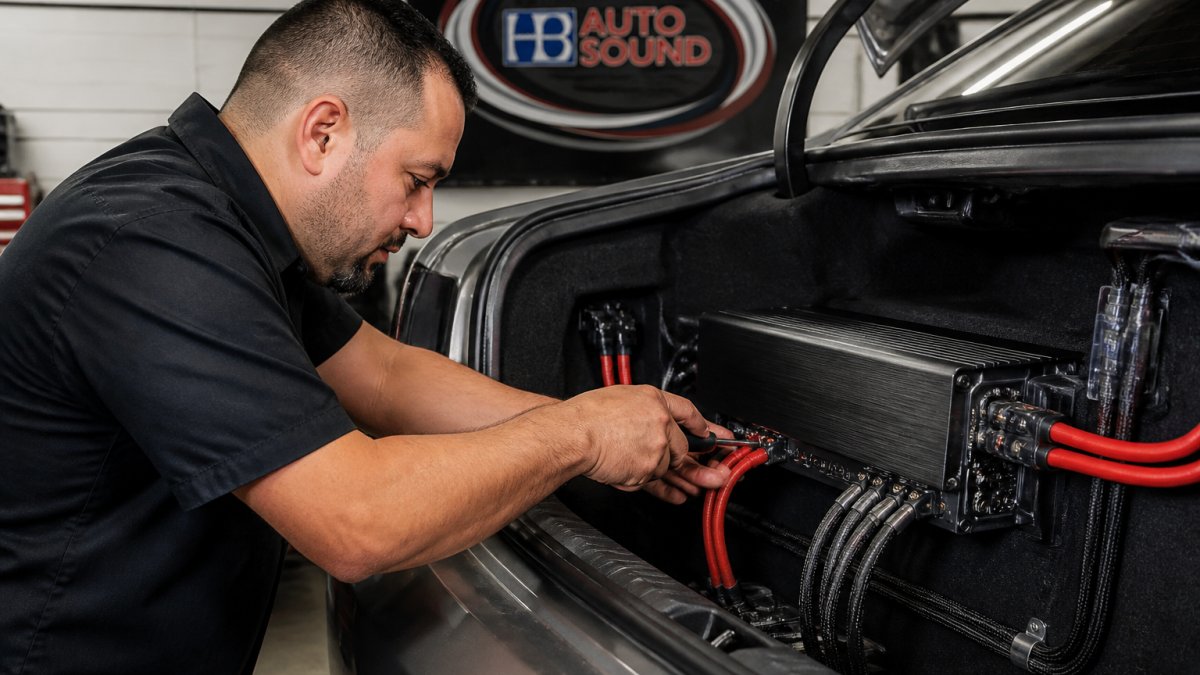
A car amplifier for factory stereo setups adds power where factory systems fall short.
Adding an amplifier increases available power. This headroom lets speakers perform as designed and gives your system the dynamic range to handle peaks without distortion.
Installation requires proper wiring, a power cable from the battery, a ground connection, a remote turn-on signal, and audio inputs.
Headless Audio Systems and DSP-Based Solutions
For enthusiasts seeking maximum flexibility, a headless audio system removes the traditional head unit entirely.
This approach offers several advantages: no dashboard real estate consumed by a head unit, complete customization of audio processing, and seamless integration of multiple sources.
A DSP-based solution is ideal for custom builds where sound quality is the priority and the driver doesn't need a traditional touchscreen interface.
Installation Complexity, Warranty, and Professional Expertise
The quality of your upgrade depends as much on installation as on component selection. A perfectly chosen head unit installed poorly will underperform and potentially damage your vehicle.
Professional installation addresses several critical concerns: proper wiring prevents electrical faults, secure mounting eliminates rattles, and factory integration (steering wheel controls, backup cameras, factory amplification) requires knowledge of your specific vehicle.
A rushed installation often results in problems that cost more to fix than the initial savings were worth.
| Upgrade Type | Complexity | Warranty Typical | Best For |
|---|---|---|---|
| Bluetooth receiver | Low | 1-2 years | Budget-conscious, minimal changes |
| Aftermarket head unit | Medium | 1-2 years | Modern connectivity, full control |
| Speaker upgrade | Medium | 1-2 years | Sound quality without head-unit replacement |
| Amplifier addition | Medium-High | 1-2 years | Power and dynamic range |
| DSP/headless system | High | 1-2 years | Custom builds, advanced tuning |
Choosing the Right Alternative for Your Vehicle and Listening Needs
Most guides to factory-stereo alternatives list options without telling you how to choose between them. Match your situation to a path, then confirm fitment and retained features before committing.
Start With Three Questions
- Is your factory radio the bottleneck, or is it the speakers and amplification? If the radio already supports the connectivity you need, the money is better spent on speakers, amplification, and tuning.
- Does your vehicle's dash and integration architecture support a replacement head unit? Integrated dashes, factory amplifiers, and vehicle settings routed through the radio raise the complexity and cost of replacement.
- What do you actually want to gain? Connectivity, sound quality, bass output, a display, or a custom-tuned system are different goals with different best answers.
Decision Guide by Use Case
| Your situation | Best-fit path | Why |
|---|---|---|
| Factory radio works but lacks Bluetooth or streaming | Bluetooth integration module or a replacement head unit with wireless CarPlay/Android Auto | Adds connectivity with the least disruption; replacement adds a modern interface if the dash supports it |
| Factory radio is fine, sound is thin | Speaker upgrade first, then amplification if needed | Speakers deliver the largest audible gain per dollar when the radio is not the limit |
| Factory system is underpowered and distorts at volume | Amplifier addition with proper integration | Headroom lets speakers perform as designed and cleans up peaks |
| You want a modern touchscreen and phone integration | Double-DIN head unit with the correct dash kit and interface modules | Delivers display, connectivity, and control in one step |
| You want maximum sound quality and custom tuning | DSP-based or headless system | Full processing control and flexible source routing |
| Vehicle has an integrated dash or luxury architecture | Professional assessment before any purchase | Retained features and fitment determine what is even possible |
Retained Features Checklist
Before choosing any path that replaces or bypasses the factory radio, confirm how each of these will be handled:
- Steering-wheel audio and phone controls
- Backup camera and any 360-degree camera system
- Factory amplifier and speaker-level signals
If any item on this list has no clear retention solution for your vehicle, that is a signal to slow down and get a vehicle-specific assessment rather than a generic recommendation.
Realistic Upgrade Tiers
Think in tiers rather than single products, because each tier changes what the next one can deliver:
- Connectivity tier, Bluetooth integration or a replacement head unit. Solves phone integration and modern sources; leaves factory speakers and amplification in place.
- Sound-quality tier, speakers plus, where needed, an amplifier and sound treatment. Delivers the largest audible improvement for most drivers.
- Control tier, a head unit with processing or a DSP added to the chain. Enables time alignment, crossovers, and tuning.
Each tier builds on the one before it. Skipping tiers is possible but usually means paying twice for the same result.
When Professional Assessment Matters Most
Some vehicles are genuinely simple: a base trim with a standard double-DIN opening and no factory amplifier. Others route climate, camera, and audio functions through the radio in ways that make a generic kit insufficient. The difference is architecture, not brand prestige. A vehicle-specific assessment answers three questions before money is spent: what fits, what must be retained, and what the realistic outcome will be.
Our approach is to recommend components for the type of use and the specific vehicle, then stand behind those recommendations with select lines chosen for reliability and customer satisfaction. Whether the answer is a simple Bluetooth module, a speaker-and-amplifier upgrade, or a full custom build with custom box and enclosures, the goal is the same: the right system for your vehicle and your ears, not a one-size-fits-all package.
Frequently Asked Questions
Can you upgrade factory car audio without replacing the head unit?
Yes. You can add Bluetooth adapters, upgrade speakers, install amplifiers, or integrate digital signal processors (DSPs) to enhance sound quality while keeping your factory head unit. These alternatives preserve steering wheel controls and factory integration. A professional installer can assess your vehicle and recommend components that work with your existing system.
What's the difference between a factory stereo and an aftermarket head unit?
Factory stereos are integrated into your vehicle's dashboard and often connect to backup cameras and steering wheel controls. Aftermarket head units are replacements that offer modern features like Apple CarPlay, Bluetooth, and touchscreens, but require proper dash fitment and may need additional adapters to retain factory features. Professional installation ensures compatibility.
Will an aftermarket stereo work with my car's steering-wheel controls?
Many aftermarket head units can retain steering wheel control functionality with the right adapter and proper installation. This requires a professional installer who understands your vehicle's wiring and can integrate the new head unit correctly. Always verify compatibility before purchasing, and work with an experienced installer to avoid issues.
Can you add Apple CarPlay to a factory car stereo?
You can add Apple CarPlay through aftermarket head-unit replacements designed with wireless or wired CarPlay, or via Bluetooth adapters that provide limited smartphone integration. A full replacement head unit offers the most seamless CarPlay experience. Consult with a professional installer to determine the best option for your vehicle type and existing system.
Ready to upgrade your car's audio system? HB Auto Sound OC offers a free consultation to evaluate your vehicle and recommend the best path forward. Our certified installers deliver professional, clean installations with custom fabrication capabilities and financing options available. Learn more about car audio upgrades from industry professionals to understand what's possible, then get in touch with our team to discuss your specific vehicle and listening needs.
Ready to Upgrade Your Ride?
Call us at (714) 842-1250 or visit us at 16732 Beach Blvd Ste A, Huntington Beach.
Get a Free Quote